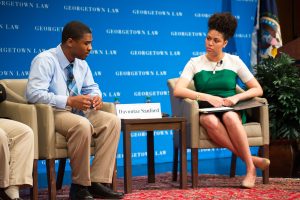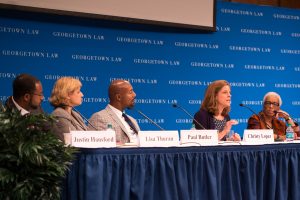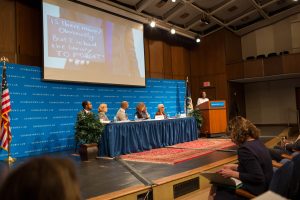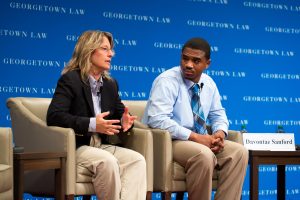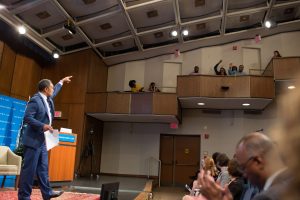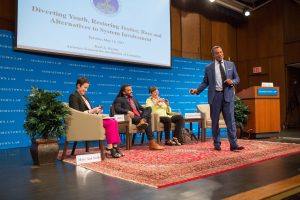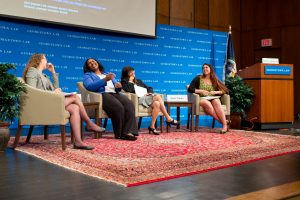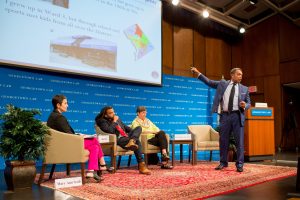
Earlier this week, WAAC joined attorneys and advocates from across the country to examine our juvenile justice system–specifically, how it fails young people of color. Like Davontae Sanford, who at 14 was wrongfully accused and convicted of a quadruple homicide. It took him nearly a decade to return home. Of this tragedy, he said, “If those detectives would have looked at me as their child, this wouldn’t have happened. I would have gone home that night.” (You can read more about his story here: tinyurl.com/z4ob8hh).
More highlights from the day:
Adam Foss, a former prosecutor whose TED talk on reimagining the legal system is sheer brilliance (watch it here: tinyurl.com/zly8w3q), said: “A criminal record is the most useless piece of paper we generate in the legal system” and later: “Acts are violent, not people.”
Christy Lopez, head investigator of the DOJ Ferguson report, noted: “You cannot understand the data divorced from the anecdotal evidence. To discount the stories of people’s experience is to devalue those experiences and their lives and the harm that these practices visit upon them.”
Professor Kris Henning said, “All of us must stand up and fight against the criminalization of normal adolescent behavior in communities of color.” Professor Paul Butler, author of the powerful book, Let’s Get Free: a Hip-Hop Theory of Justice, said, “The police have an extraordinary amount of power. And we heard from [WAAC] earlier that they use this power against African American people especially when they don’t use that in situations with white people. So sometimes people say, what would the black community look like if the police didn’t enforce the laws? If the police didn’t try to lock up everybody they see committing a crime. The answer is it would look like the white community. That’s pretty much what happens with white people now… What we need to be concerned about at the end of the day is this racialized exercise of discretion by police and how it’s not about public safety.”
DC Attorney General Karl Racine said of WAAC, “I can tell you that I’m a criminal, and I didn’t get arrested a lot because I was around Ward 3. That’s where we grew up. We were very fortunate… no doubt that zip code helped me out a ton.” Dr
Daniel Murrie cautioned against reliance on risk assessments, stating, “Each of us is dangerous in the right context.”
Dr Jamilia Blake, regarding school resource officers, said, “We must reenvision what it means to support children.”
The final panel talked about solutions, specifically: restorative justice. “Restorative justice isn’t just developmentally appropriate, it’s humanly important,” said Dr Laura Abramson.
We at WAAC couldn’t agree more.